kWh Analytics expands Solar Revenue Put team

kWh Analytics has expanded its team to accelerate the adoption of the Solar Revenue Put with the addition of Sam Barton, Colin Schneider, and Alex Deng, three experienced business development professionals with significant knowledge of renewable energy project finance.

“2020 set a new record for market adoption of the Solar Revenue Put, which we believe will be exceeded in 2021. We are expanding our team to meet the needs of our clients within the hyper-competitive solar industry,” said Richard Matsui, Chief Executive Officer. “Our new hires’ insights will help advance the growth of the Solar Revenue Put and kWh Analytics’ position as the insurer for the Energy Transition.”

Sam Barton joined kWh Analytics from Silicon Valley Bank (SVB), where he served as Vice President of Project Finance. Previous to SVB, Sam held roles at Tesla and SolarCity, supporting structured finance for renewable energy projects. Sam brings over 10 years of experience in solar project finance and business development. He holds a BS in Environmental Engineering from the University of California, San Diego.

Colin Schneider joined kWh Analytics after serving as the Head of Solar Acquisitions at Gardner Capital and the Vice President of the Renewable Energy Infrastructure Group at Bridge Bank, a group he helped found. Colin has a wealth of experience leading the development of millions of dollars of solar assets over 10 years. He holds a BS in Finance from Santa Clara University.  

Alex Deng joined kWh Analytics from Advanced Power where he supported project finance, acquisitions, and development. Before Advanced Power, Alex worked at Soltage and the Glenfarne Group, supporting renewable energy project development and asset management. He also holds a BA in Economics from New York University. 

For more information on the kWh Analytics team, visit https://www.kwhanalytics.com/.

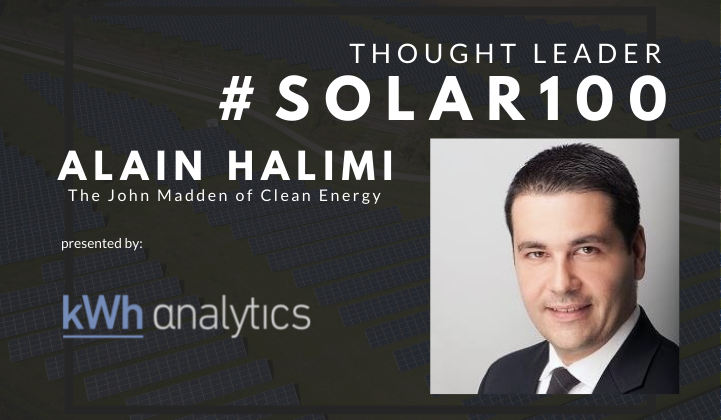
#Solar100’s Alain Halimi: The John Madden of Clean Energy

Originally posted in Forbes.

In this edition #Solar100, Founder and CEO of kWh Analytics Richard Matsui speaks with Alain Halimi, Executive Director of Natural Resources and Energy at Commonwealth Bank of Australia.

Alain Halimi is known for his significant experience in clean energy financing. He has spent over 15 years supporting the development of renewable energy in the US and internationally and has provided his insights at numerous conferences over the years. Like John Madden, he’s coached and supported his teams on numerous successful clean energy deals and he’s a known color commentator in the industry.

In this Solar100, Alain Halimi weighs in on his experience financing renewable energy assets, how the renewable energy market has evolved over time, predictions for energy storage, and his thoughts on how the industry can continue to advance diversity and inclusion.


STARTING OFF IN RENEWABLE ENERGY FINANCING

Richard Matsui: You’re a Frenchman, working for an Australian bank, living in New York City, financing renewable energy. Can you talk me through how you ended up here?

Alain Halimi: I think that’s the way the world works now. Everything and everyone is becoming more and more integrated. It’s also a good reflection of what’s happening with the clean energy movement — it’s happening all over the world.

In terms of my career, I studied banking in college in France and found a job at a French-Belgian bank called Dexia. We actually started working on our first wind deals there in 2004-05. They were very active in clean energy at the time and were already closing 10 to 15 wind farm deals a year. Then, Dexia gave me the opportunity to move to the United States and I wanted the opportunity to learn about other international markets, so I came here in 2006.

Once I arrived in the US, I worked on my first wind deals. At the time the renewable energy market started to be fairly active with large wind projects due to the establishment of Renewable Portfolio Standard (RPS) targets and the Production Tax Credit (PTC). Then around 2010, I wanted to explore new industries, so I moved to BNP Paribas. There, my focus was more around natural resources. I had a great experience working there across Investment Banking and Debt Capital Markets, but in 2014, Commonwealth Bank of Australia (CBA) had an open position in its Natural Resources and Energy group. Given my experience at Dexia in clean energy and at BNP Paribas in Natural Resources, the role was a perfect fit.

Seven years later, the CBA platform has materially grown where we are now leading large wind, solar, and standalone battery storage projects across the US. CBA was an early mover in the space and at the forefront of this major energy transition. Over the years, we have been able to provide financing solutions assisting our clients to fund their renewable energy projects in the US.


RENEWABLE ENERGY FINANCING MARKET EVOLUTION

Matsui: How has the market evolved since ‘04?

Halimi: The market has evolved a lot in terms of competitiveness, understanding the technology, financial structure and risk appetite. Everyone from banks to equity investors have been getting up to speed, so financial institutions have increased their risk appetite over the years, especially given the historically strong track record the sector has experienced.

In the beginning, I remember we had to rely on only one year of data for some of the first wind farm deals we completed, and some of the assets we financed didn’t necessarily perform as planned; but, the market has certainly learned a lot from those early deals. Similarly, on the solar side, I remember working on my first solar project in 2008. It was an 11MW solar project and was probably considered one of the largest projects in the US at the time. However, over the past few years, solar projects have now become a key asset class within the renewables space with an average deal size of 150+MW. Additionally, the cost of solar modules has fallen by 94% over the past decade and is now undeniably one of the cost effective sources of power generation in the US.

Standalone battery storage is poised to follow a similar arc to solar, based on where the solar market was a decade ago. For example, the cost of lithium-ion batteries, has fallen by 86% and efficiency has grown dramatically over the same period. I think the industry will continue to grow quickly with larger scale battery projects, since storage is one of the key technologies and solutions available to green our power grid.

Matsui: There have been a lot of macro changes in the past year: we are in a global pandemic and now, we have the Biden administration pushing to deploy more renewables. How have the last 12 months impacted renewable energy financing and the market as a whole?

Halimi: Generally, the market has continued to grow. All industries are somewhat in competition with each other to attract capital, but in the past 12 months, even with everything that has happened, there has still been significant support for clean energy. That is just a reflection of a few factors. First, the renewable energy sector has historically been a solid asset class given its contracted nature and resilience to macro shocks. This asset class has been far less volatile than other asset classes, historically speaking. Those features have naturally attracted more capital. Second, there has been a growing awareness of the energy transition. COVID has certainly accelerated the trend to do more in the space and key players from governments to investors to boards have made a renewed commitment to taking the conversation to the next level. We are certainly at the beginning of a global energy transition and in the US, the industry will continue to grow an increasing share of the market within the power grid.

RENEWABLE ENERGY FINANCING TRENDS: PREDICTIONS FOR 2021 REFINANCINGS

Matsui: We recently surveyed lenders for our annual Lendscape update and interestingly, almost all the lenders said that they focused on financing new-build projects in 2020, rather than refinancing operating projects. Commonwealth Bank of Australia is an obvious exception, since we were fortunate to be able to work with you on a sizable refinancing last year. What role do you think refinancing will play for the rest of 2021?

Halimi: I think refinancing will likely play a bigger role in the market this year and next, since a lot of projects were built five to seven years ago and will be reaching the end of their loan terms. We track this closely.

On our side, we completed one sizable refinancing last year, but that happened because the sponsor simply wanted to optimize the terms and also ensure the credit aligned with the asset’s strong performance. We are working on another refinancing and we are looking at a few financing solutions to further optimize the structure for the developer, given the good performance of the underlying solar project. The Solar Revenue Put can certainly help to sharpen those returns for the sponsor and mitigate production risk for the lenders. For instance, on the refinancing we led, the Put allowed the sponsor to hedge themselves against energy production risk while optimizing underlying leverage. That was an effective solution and the process was fairly straightforward to execute on. The kWh team made that process simple for everyone, including the sponsor and the banks that were new to it.

THE NEXT FRONTIER IN FINANCING: ENERGY STORAGE

Matsui: For the most part, everyone agrees that storage is the next frontier, but there haven’t been many deals completed to-date. So, can you give me a snapshot of your perspective on storage today? What’s financeable and what’s not?

Halimi: Project financing for battery storage really varies based on the project.

One type of project is where you have co-located solar and storage and the solar assets feed the battery. For those deals, it’s generally straightforward to finance as it’s considered a fully integrated solution, so you can apply similar principles to wind or solar financing.

The second type of project is where the battery serves as a peaker plant. For instance, we recently closed a financing as a bilateral credit facility where the project is partially contracted with Southern California Edison (SCE) to install a standalone battery to act as a peaker to replace gas units. In this case, the challenge on the financing side is securing a revenue stream. You usually have a capacity contract with the utility, but that does not generate much revenue. The real revenue will come from arbitrage, but the challenge becomes figuring out how to buy and sell electricity from the battery at the right time.

So, that’s where we’re focusing on now – understanding the location of the asset, the market it will be operating in, how the developer is managing energy deployment and the software it plans to use for that process…etc.

LOOKING AHEAD

Matsui: Lastly, moving forward into 2021, we’re going to be asking everyone in the Solar100 series about racial equity in the solar industry. The thought is that the solar industry is of course important because of climate change, but it’s also important because of jobs—there are a lot of people who work in this industry or want to work in this industry. As a respected renewables leader, what are your thoughts on how the industry can continue to improve in this important area?

Halimi: I agree that is an important topic to discuss. In clean energy, there’s a huge value chain – from manufacturing to operations to finance – which requires a lot of different types of expertise and all together, can bring social justice with economic advantages to local communities.

Our economy has been reliant on fossil fuel and that has had significant impacts on the health and pollution of communities, particularly those that have already suffered from other negative socioeconomic factors. The renewable energy sector can be a key tool, not only by contributing to the energy transition, but also in providing opportunities and support for those that the fossil fuel industry has impacted by offering access to affordable and safe power.

So far, the industry has been a key job creator and has provided opportunities for training throughout the entire value chain. The industry has also enabled entrepreneurship opportunities, although we could do additional work to ensure these opportunities are equitable and fair to everyone. There have been some positive initiatives in the US to support diversity and inclusion, including dedicated funding and tax credits for Opportunity Zones and initiatives from industry groups such as the Solar Energy Industries Association (SEIA) and American Council on Renewable Energy (ACORE). Also, some developers have made direct commitments and specific targets to build a diverse and inclusive workforce. 

However, a lot more still needs to be done. Although the level of awareness has increased, this needs to be translated into action. Trying to use examples from other industries, one idea that may improve equity is to offer asset ownership to local communities to build equity and align interests. Companies and governments should also work together to invest in developing a more diverse, equitable and inclusive workforce by creating a culture of inclusivity and accountability. asd

Norton Rose Fulbright’s Project Finance NewsWire

Originally posted in NRF’s Project Finance NewsWire April 2021 edition by Keith Martin.

About 15% of US solar projects will reach the end of the recapture period for investment tax credits this year, presenting opportunities for private equity and pension funds looking to buy assets and for lenders looking to do refinancings. Many US solar projects are financed in the tax equity market.

Tax equity accounts for roughly 35% of the capital stack in a typical solar project, plus or minus 5%. A sale of a project within the first five years after it is put in service will cause part of the investment tax credit claimed on the project to have to be repaid to the US Treasury. This lock-in effect makes it hard to sell such projects directly for at least five years. However, private equity and pension funds can still buy the developer interest without triggering significant recapture in cases where projects have been financed with tax equity to the extent the tax equity papers allow the developer to shed its interest during that period. The sale of the developer interest usually triggers recapture at most of only 1% of the investment tax credit claimed.

kWh Analytics expects more refinancings of large solar projects in the next few years as solar projects that were installed in the last five years start to roll off tax equity financings. Its Lendscape survey of solar project finance lenders in March found that little to none of their business in 2020 was refinancings. About 14,000 megawatts of projects were put in service in 2016. Seventy-nine percent of lenders surveyed said that their spreads on loans are currently at or below pre-COVID levels.

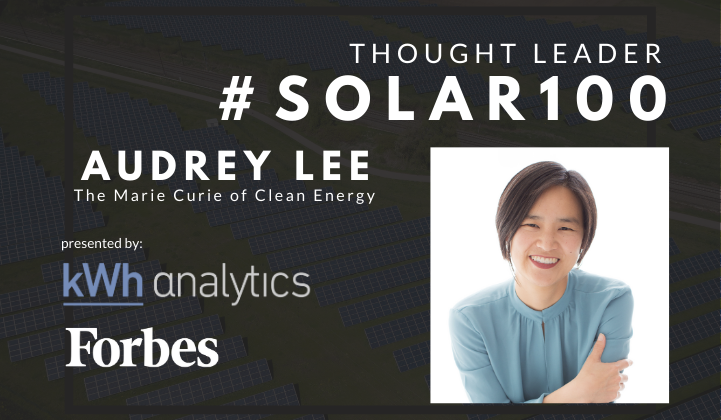
#Solar100’s Audrey Lee: The Marie Curie of Clean Energy

Originally posted on Forbes. In this edition of #Solar100, CEO and founder of kWh Analytics Richard Matsui speaks with Clean Energy For Biden co-chair, ArcLight Clean Transition director, and senior director of energy strategy at Microsoft, Audrey Lee.

Audrey Lee is known for her significant public and private sector impact on the clean energy and sustainability industry. Like Marie Curie, Audrey has channeled her scientific background into developing practical and actionable solutions for the industry’s toughest challenges. Her career highlights include co-founding Clean Energy For Biden and serving as a senior executive for notable industry brands, like Sunrun, Proterra (via ArcLight), and now, Microsoft’s energy team.

In this Solar100, Audrey Lee weighs in on her experience mobilizing nationwide support for Clean Energy For Biden, identifying target companies for ESG-focused Special Purpose Acquisition Companies (SPACs), and her advice for building a career in renewables.

INSPIRATION FOR WORKING IN THE ENERGY INDUSTRY

Richard Matsui:   Starting from the beginning — I saw that you started off in physics and then went on to receive your doctorate in electrical engineering. What inspired you to get started in energy in particular? 

Audrey Lee: In grad school, I wanted to do something in sustainability. At that time, there was only one professor in my department working on solar cells, and it was hard to find something to do in that space. So, I started talking to people in the public policy school at Princeton and really got into energy policy.  

What attracted me to energy is that it’s just so critical to society and the economy; it’s a basic piece of infrastructure. There is a great opportunity within the energy industry to take basic infrastructure and be able to put in new technology to make it more sustainable, and I think that’s a basic requirement for the electricity grid: you want it to be both sustainable and reliable. Also, you want customers to have a choice in the kind of energy that they’re getting. 

Matsui:  Building on that sense of dualism and thinking about your career, I noticed you’ve held roles in both the public and private sector. How do you think one sector informs the other and vice versa?

Lee: Because energy is such a regulated industry, I don’t think you can disentangle the public and the private sector. And for our industry to grow, I think we need more exchange between the two. 

CLEAN ENERGY FOR BIDEN

Matsui: You’re currently a co-chair for Clean Energy For Biden. Can you give a brief overview of the organization and what you’re trying to achieve?

Lee: Honestly, we were a bunch of people in the clean energy industry that wanted to see Biden elected, really just a loose network of business leaders and advocates. Our goal was to advance policies, technologies, and investment to address climate change.

We had three simple goals: one was fundraising, two was to get out the vote, and three was policy. We started around April with just a handful of us, when it became apparent that Biden would be the Democratic nominee. Since then, we’ve grown to 15,000 members.

Matsui: That’s incredible! At least ten times more than I would have guessed.

Lee: Yeah! It’s a testament to how much the clean energy industry has grown. It’s been really awesome to see the response.

What makes Clean Energy For Biden unique is how grassroots it is and how we’ve gotten so many volunteers involved. We’ve had hundreds of volunteers helping us organize. 

In total, we raised more than $3.2 million and had more than 100 fundraisers. We also have 30 state and affinity teams across the country. Because the policies from different states and different regions can be so different, and what clean energy means in different states can be different as well, we wanted to make sure we had that regional representation in our teams. How the teams organized and talked to voters was really important. 

Then, we made an announcement at our Inaugural Ball that we’re transitioning to Clean Energy For America. So, now we’re hiring a CEO while trying to keep that grassroots and matrixed national and regional team structure.

Matsui: I come from a background in diplomacy, and one of the things you learn in diplomacy is that there’s a fundamental tension in coalition building. To some extent, you want the biggest tent possible. But it’s also true that the bigger the tent, the harder it is to actually get stuff done. So with that line of thinking — what are the priorities that this group would want the Biden administration to execute? 

Lee: That’s a very good question, and I’m going to encourage you and many others to join and help us figure it out!  We want to keep that grassroots nature of the organization and work with our volunteers to decide how we can continue to be impactful  – choosing which elections to engage in, advocating for clean energy policy, and educating the public about clean energy. We also plan to raise funding to support resources for these grassroots teams. 

Matsui: To your point, it’s surprising to hear that this grew from ten people in a room to 15,000. Any experiences there that surprised you, given the diversity of people and regions participating in Clean Energy for Biden? 

Lee: Actually, it was only six people on a Zoom call at the end of March 2020. 

Yes, I think you can look at what we did for the Georgia Senate Race. After the election in November, we provided support for the runoff and the messaging there was directed to that audience. We already had an existing Georgia team that was organized to elect Biden, and we were sensitive to what would be successful there to elect the two Democratic candidates for Senate. 

For instance, when you phone bank in the south, it’s better to call someone ‘sir’ or ‘miss’ and be very polite and call them by their last name. Usually in the scripts, you don’t use genders; you say their first name. You say, ‘Hello, Jane.’ But in the south, it should be ‘Hello, Mrs. Smith.’ So, it was the little things like that that we learned from the Georgia team.

Matsui: A good friend from college was recently elected in Georgia, and I’ve been surprised to learn that when it comes to clean energy, that my home state of Hawaii and Georgia actually share a lot in common. Everyone wants good jobs and clean air.

SPECIAL PURPOSE ACQUISITION COMPANIES (SPACs)

Matsui:  In addition to being a part of Clean Energy for Biden, you’re a board member on ArcLight’s SPAC.  SPACs are making big waves in our industry. Based on your experience at ArcLight, what type of company makes for a good target for a SPAC nowadays?

Lee: ArcLight Clean Transition went public in September of last year, and when we came out, our goal was to identify and take public a leading clean energy or sustainability company. We had raised $278 million and we were looking for a company around the $750 million to $2.5 billion valuation range. 

We are very excited about our transaction with Proterra, a leader in commercial vehicle electrification. Under the agreed deal, the company was valued at $1.6 billion enterprise value and we raised an additional $415 million, meaning that Proterra will have $825 million in cash to continue to invest in the business.

What’s really exciting about Proterra is that it’s not just about electric buses. They have Proterra Transit, as well as Proterra Powered, which provides power train and battery packs for vehicles, and also Proterra Energy, which provides charging infrastructure management. And so, if you look at their public documents, you can see that a lot of the growth opportunity is not just in electric buses, but also these other areas. 

Matsui: Right. But there’s such a wide range of companies getting support from SPACs right now. Can you expand upon the criteria that people in your shoes are using other than valuation? Shayle Kann from EIP says that there has been 40 SPAC mergers in climate tech announced so far.

Lee:  I can’t speak for other SPACs, but we looked for strong revenue growth, a large near-term order backlog that gave us financial performance visibility, and a clear plan for profitable growth. Additionally, we assessed how the target would use the proceeds to accelerate their growth. I recommend looking at the Proterra/ArcLight investor deck to see how Proterra answered these questions. 

Another, probably obvious, thing to note is that SPACs turn private companies into public ones. So, part of our role is looking for companies that public investors can understand and want to invest in. From that perspective, electric vehicles are not too esoteric. 

Matsui: Following that line of thinking, my impression is that the ESG SPACs have first chosen to invest in electric vehicle (EV) space. I suppose EVs are easy for a retail investor to understand — thanks to Telsa — but I would have thought that solar would be equally easy. Do you have any thoughts as to why SPAC investment in solar appears to be a step behind? What does that say about what SPACs tend to be looking for?

Lee: The SPAC phenomenon has come upon us so quickly that everyone is trying to learn about them and understand whether it’s the right fit for their company and for what the company wants to do to grow. So, I think part of it is letting the whole SPAC formula catch up. 

Matsui: I can understand that. What structural changes do you think the SPAC trend will cause in our industry?

Lee: I personally see it related to the momentum that we are gaining in terms of addressing climate change.  I think there’s real hope that we will be more ambitious in passing climate change policy and developing more clean energy, and that excitement is related to the excitement in investing in clean energy.  

I’m also seeing investors rethink their approach. Firms generally have an approach for investing in oil and gas or even utility-scale renewables. But, they now need to think about how our electricity grid and transportation is going to evolve and how distributed energy and all these other types of resources will interact. This adds complexity for investors, because it’s not like investing in a centralized power plant. This means we need to develop new investment mechanisms for these new types of technologies, because we see this clean energy transition coming.

If you take a firm like ArcLight, which has traditionally invested in gas or large-scale utility and wind assets, they have an infrastructure fund to do that. And in this case, by using a SPAC, the firm had the ability to invest in software, services, and technology in the energy space that their traditional infrastructure fund can’t invest in. 

MOVING FORWARD: ADVICE FOR YOUNG PROFESSIONALS & INDUSTRY OUTLOOK ON DEI

Matsui:  What lessons learned from your career can you share with young professionals looking to work in clean energy?

Lee: Honestly, I found it challenging to join the private sector from the public sector, because I didn’t have any product or business development experience in my resume. People didn’t really know what to do with the skills that I had in public policy and government. Luckily, Susan Kennedy also had a background in government and recognized how transferrable my skills could be. And that was a great opportunity to be able to prove myself, to be able to make that shift.

I also think being at a start-up was great, because I was able to wear many hats. I was the first employee at AMS, and I learned so much. Being at a smaller company was a great way to prove myself. Then Sunrun recruited me to work on their technology platform and more and my previous experience gave me the authority to run the P&L (profit and loss) for energy services there, expanding my responsibilities from data science, software, and product to business development, go to market, and financing. 

My advice is to pursue what you’re curious about. I want to learn new things and learn new skills. I think what I found challenging in graduate school is that I didn’t get a lot of exposure to what’s possible — what you see around you is academia. And so, I had to push myself to talk to people. I would cold call people, get informational interviews, and try to understand how the world outside academia works. I probably interviewed a hundred people. So for those earlier in their career, don’t be shy! People love to give unsolicited advice.

Having my doctorate was a nice credential on my resume as well. I remember I was at a dinner meeting in Texas with about 80 people and people at my table said, “You look 18…You have  Ph.D.!? Okay maybe you’re 22… You have two children!?… Okay maybe you’re 25.” I was 39.

Matsui: I personally run into a similar problem, and honestly, I don’t have a great solution to it. Do you have any recommendations about how to approach those situations?

Lee:  I try to launch into the discussion immediately. I like to get in front of the whiteboard and start solving some problems together. It can be annoying in the first five minutes when you’re exchanging pleasantries and people think that I’m an assistant, but then I can get into the subject and quickly disbar that.

Especially in the energy industry where you have people with decades of experience, it becomes a question about how can you learn from people with that experience, while also bringing in new ideas and new models. Having diversity helps with that.

Matsui: Certainly. Do you see any group modeling the kind of behavior that you think the industry should be adopting in terms of DEI?

Lee:  I think you can take my experience being on the board of ArcLight Clean, which is a public company in a way, although not a standard public company. Generally, the standard mold for a board of directors is to look for someone with decades of experience — an ex-CEO or CFO — and instead, I’ve been given this great opportunity to join the board and provide my perspective as someone with a greater understanding of the customer, the technology, and policy and the implications of that. In that sense, I think board diversity will continue to be really important. 

Going back to our discussion about my early career and how I wanted to work on sustainability and I didn’t know how, reminds me of what’s great about our industry: we come from all sorts of backgrounds and it’s important to continue to add more diversity.

Source:https://www.forbes.com/sites/richardmatsui/2021/04/01/solar100s-audrey-lee-the-mari

CleanCapital’s Expert’s Only Episode 87 with Jason Kaminsky

Our COO, Jason Kaminsky, joined Clean Capital for an episode of Expert’s Only. He discusses the next phase of solar and best practices to use data to better manage assets and ensure predictable revenue. Jason and Jon spoke about the next phase of solar and the cutting edge advancements they’re making in data management.

“Our team enjoys working closely with kWh, as they’re a market leader in solar risk management, and we’re thrilled to welcome Jason to the show.” – Jon Powers, Clean Capital

Source:https://cleancapital.com/2021/03/episode-87-solar-risk-management-with-jas

1 11 12 13