San Francisco, CA, November 8, 2022 – kWh Analytics, the market leader in Climate Insurance, today announced that it has structured a Solar Revenue Put supporting back-leverage financing with Matrix Renewables, the TPG Rise-backed global renewable energy platform, insuring solar production on 143 MW of new-build utility-scale solar projects. For the first time, the Solar Revenue Put policy will provide coverage for the full 26 year amortization term. The projects, Gaskell West 2 & 3, are financed by major lending partners MUFG, HSBC, Commonwealth Bank of Australia, and National Bank of Canada.
The Solar Revenue Put is an insurance policy covering solar production to provide protection against downside risk. The policy serves as a credit enhancement for financial investors, allowing asset owners to achieve more favorable financing terms. The addition of the Solar Revenue Put including Base and Supplemental Coverage has significantly reduced Matrix Renewables’ DSCR sizing requirements, and provides 26 total years of production insurance.
“The passage of the Inflation Reduction Act has accelerated demand for renewable energy projects. Our product allows sponsors to deploy more MWs using less capital, something that’s increasingly important in today’s rising cost environment,” says Jason Kaminsky, kWh Analytics’ CEO.
The Solar Revenue Put has insured production for nearly 3GW of renewable generation capacity, including portfolios ranging from thousands of residential rooftops to utility-scale plants. Portfolios backed by the Solar Revenue Put are able to support higher leverage levels or lower credit spreads, reducing equity checks while mitigating downside risk. The Supplemental Coverage extends these debt sizing and risk mitigation benefits beyond ten years, to match the term of debt amortization.
ABOUT Matrix Renewables
Matrix Renewables is a renewable energy platform created and backed by global alternative asset manager TPG and its $15 billion impact investing platform TPG Rise. Matrix Renewables’ current portfolio is comprised of 2.3 GW of operational, under construction, or near ready-to-build solar PV projects and a further 7.3 GW pipeline of renewable energy projects under development, across North America, Europe, and Latin America. For more information, visit matrixrenewables.com or send an email to info@matrixrenewables.com.
ABOUT KWH ANALYTICS
kWh Analytics is a leading provider of Climate Insurance for zero carbon assets. Utilizing their proprietary database of over 300,000 operating renewable energy assets, kWh Analytics uses real-world project performance data and decades of expertise to underwrite unique risk transfer products on behalf of insurance partners. kWh Analytics has recently been recognized on FinTech Global’s ESGFinTech100 list for their data and climate insurance innovations. The Solar Revenue Put production insurance protects against downside risk and unlocks preferred financing terms, and the Renewable Energy Property Product offers comprehensive coverage against physical loss. These offerings, which have insured over $3 billion of assets to date, aim to further kWh Analytics’ mission to provide best-in-class Insurance for our Climate. To learn more, please visit https://www.kwhanalytics.com/, connect with us on LinkedIn, and follow us on Twitter.
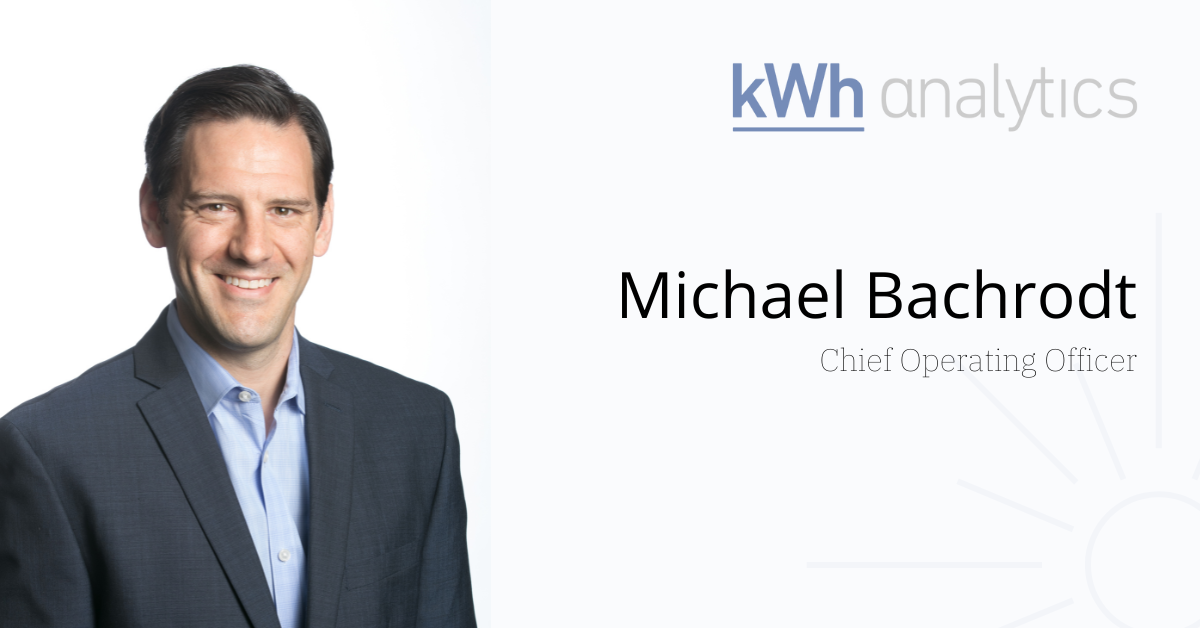
San Francisco, CA – September 29th, 2022 – kWh Analytics, a leading provider of Climate Insurance for renewable energy assets, announced that it has named Michael Bachrodt as the company’s new Chief Operating Officer.
The news comes on the heels of kWh Analytics’ $20 million Series B funding announcement, which ushered in a new era of rapid growth for the firm. kWh Analytics has also recently been recognized on FinTech Global’s ESGFinTech100 list for their data and climate insurance innovations. “We’re entering an exciting new phase as we continue to scale and launch new products that support the energy transition,” said Jason Kaminsky, CEO of kWh Analytics. “Michael’s combination of insurance and renewable energy finance expertise and considerable executive leadership experience makes him a perfect fit for kWh Analytics.”
Bachrodt has over 20 years of project finance, transaction management, and underwriting experience, most recently serving as Vice President, Structured Finance for OYO Hotels. Bachrodt’s work at OYO saw him lead global debt and growth capital initiatives. He also served as Senior Vice President for Bridge Bank, where he led the renewable energy project finance group. In prior roles, Bachrodt led project finance transactions at SunEdison and negotiated power purchase agreements at Pacific Gas & Electric Company.
“kWh Analytics has tremendous growth prospects. They are truly proving themselves as data-driven leaders in renewable energy and asset insurance,” notes Bachrodt. “I’m thrilled to join this enterprising team at such an exciting time.”
Bachrodt earned his MBA from Harvard Business School, and holds a bachelor’s degree in business administration from the University of Notre Dame.
ABOUT KWH ANALYTICS
kWh Analytics is a leading provider of Climate Insurance for renewable energy assets. Utilizing their proprietary database of over 300,000 operating renewable energy assets, kWh Analytics uses real-world project performance data and decades of expertise to accurately price and underwrite unique risk transfer products on behalf of insurance partners. The Solar Revenue Put production insurance protects against downside risk and unlocks preferred financing terms, and kWh Property Insurance offers comprehensive coverage against physical loss. These offerings, which have insured over $3 billion of assets to date, aim to further kWh Analytics’ mission to provide Insurance for our Climate. To learn more, please visit https://www.kwhanalytics.com/, connect with us on LinkedIn, and follow us on Twitter.
Originally posted in Origis Services’ Power Players RE+ 2022 Special
Sarath Srinivasan, Vice President, Head of Product of kWh Analytics, joins Power Players host Michael Eyman to discuss the 2022 Solar Risk Assessment Report and the critical industry issue of solar asset underperformance. The pair discuss the implications of the Inflation Reduction Act, the importance of accurate P50 estimations, and the consequences of underperformance on equity cash flows.
“Data analyst Hao Shen is following his growing suspicion. “We thought that more modern photovoltaic systems would be more reliable and efficient than those commissioned 10 years ago.” Shen is the head of data products at data analytics and climate insurance firm kWh-Analytics.
The company has compiled performance data from the portfolios of 15 of the 20 largest system operators in the United States. It then compared the revenue reports prepared before the plants went online and the actual production data. That comparison, covering 30% of ground-mounted plants in the United States, showed “just the opposite is true,” Shen says. The discrepancy between predictions and real output has increased.”
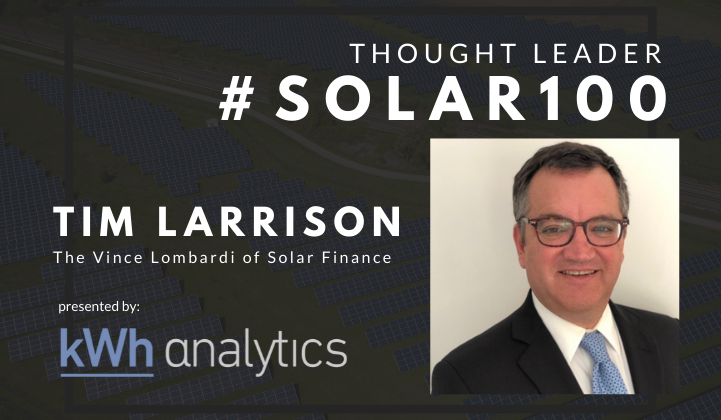
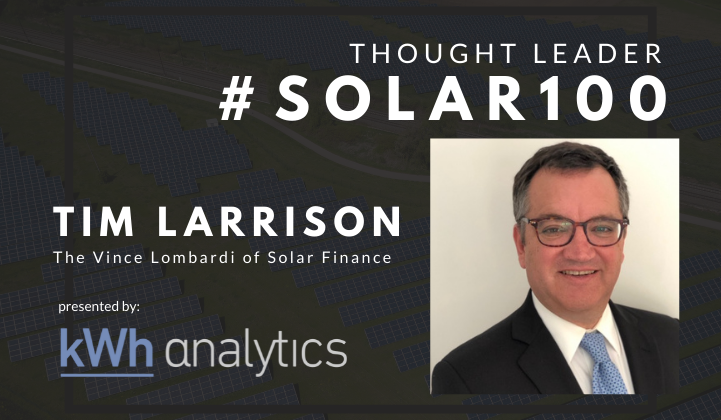
In this #Solar100 Interview, Richard Matsui, Co-Founder & Chief Strategy Officer of kWh Analytics, speaks with Tim Larrison, CFO of Primergy Solar.
Over his long career in renewable energy, Tim Larrison has steered companies through periods of significant growth with his keen insight on the energy industry’s biggest finance problems and his focus on fundamentals. Like the legendary Vince Lombardi, Larrison has a relentless commitment to the blocking and tackling of managing a business, and the success of this strategy has culminated in his current position at Primergy Solar, which melds his operational finance background with opportunities to do large, creative structured financing.
In this Solar100 interview, Larrison discusses his career in energy, solar’s project finance problem, emerging storage technology, solar’s next major hurdle, and career advice for future CFOs.
THE LONG AND WINDING ROAD TO RENEWABLES
RICHARD MATSUI: You’ve obviously had a long career in solar, but I didn’t realize you also had experience in different sectors. Can you walk me through your career trajectory and how you ended up at Primergy Solar?
TIM LARRISON:
It has been a long road to Primergy Solar, I’ve been in and out of the energy industry, but I’ve always been on the finance side of things.
I started nearly 30 years ago at Ernst and Young and was involved in advisory for Eastern European energy companies as they were coming into the international fold. I was assigned to work in Kazakhstan when it first became an independent country. It really was the Wild West – pre-internet and no international landlines. This sparked my interest in international emerging markets, and I decided to go to London Business School for my MBA.
During business school, Enron was on the rise, and I got a job as a summer associate. The first project I worked on resulted in a $2.4 billion acquisition of Wessex Water Company and I was hooked. I stayed on after I graduated, and that’s when my infrastructure and power work began.
When I left Enron, I knew that I wanted operational finance experience versus the pure transactional experience I had up until that point. Operational finance is a different animal and I felt that I needed it to round out my skill base. I had a couple of senior level operational finance jobs and ultimately ended up as the founding Chief Financial Officer (CFO) of CLEAR in New York. It was a great role, but ultimately, I missed being a part of the energy industry.
A lifetime later, I took a job at as the CFO of a venture-backed startup that was mining lithium in the Salton Sea. They had a great idea, but major project finance problems. I saw this problem across Silicon Valley: people forgot that they were in the energy business, where 20x multiples just don’t happen. There was a massive disconnect between venture capital expectations and the realities of the energy industry.
From there, I joined Yingli and had a great run with a phenomenal team. This was at the beginning of the solar ramp up in the US and I think there was a point that we brought in 20-25% of all the panels in the US. It was a fantastic job because I was able to get exposure to the whole solar market and understand where the market was headed.
Although the solar sector was booming, the industry was missing something critical. It became apparent quickly that solar is an incredible opportunity, but it requires a different lens. I remember visiting SunEdison and seeing hundreds of employees managing what was essentially three mid-sized solar power plants; it was never going to work. They weren’t doing anything differently from managing a coal plant or a gas-fired power plant…there was a lot of overhead.
At the end of 2019, an Operating Partner at Quinbrook Infrastructure Partners asked me if I wanted to build out Quinbrook’s investment platform for solar and storage, Primergy Solar. The people at Primergy understand that solar needs to be managed as an energy business rather than a venture-backed startup. A perfect combination of being an operational CFO and being able to work on large, creative structured financing; this ties all my experience together and I couldn’t be happier.
LESSONS LEARNED & CURRENT TRENDS IN SOLAR
MATSUI: How does it feel to be back in the energy industry, where your career started?
LARRISON: It’s an exciting time to be in renewable energy and I am very happy to be in the industry now because we’re doing a lot of good work. Primergy is a perfect place to have an impact – we are growing and have the backing of a fantastic investment fund that is committed to zero carbon investing. We are fortunate to have a leadership team that are all operators who understand the challenges of being in the energy business. But, at the end of the day, it’s still the energy business. And I can’t stress that enough.
There’s an incredible amount of innovation within renewables; kWh Analytics is a great example of that constant innovation. I love the fact that there’s always twists on what has happened before. It builds on old ideas.
MATSUI: Thanks, Tim. We draw inspiration from history, and credit enhancements like the Solar Revenue Put are an old idea. As a former consultant, you learn that there are very few, truly novel ideas.
One of the smartest people I met in solar, Dan Pillemer, once observed the same dynamic you did. He said, “I don’t understand why all of these solar lease/PPA companies, a consumer finance business, are locating their teams in the Bay Area, one of the most expensive cities in the world.”
What else has your prior experience taught you about solar?
LARRISON: One of the hot topics for me – though it’s a cliché – is maturity. With maturity, we’re seeing bigger projects. In fact, we just announced momentum on our cornerstone Gemini Project, which is one of the largest solar + storage projects in the United States. But it won’t be the largest for long. With the way that financing tends to be set up, it’s around a lot of value on tax equity. For reference, the tax equity check for Gemini is 4-5% of the total tax equity market.
I don’t think the way these projects are being financed is sustainable. The industry needs to look at traditional power financing. You often hear that if the ITC went away, it would be the end of the world. But change happens all the time. The energy industry survives. When the industry comes across issues that prevent it from growing, it’s time to do something different.
MATSUI: A great colleague of mine, Alex Deng, has the dubious honor of having financed the industry’s first truly merchant utility-scale solar project in his past life. No tax equity was involved. It’s painful, but it can be done. Our industry is kind of addicted to these “25% off” coupons from the federal government.
LARRISON: Right, and the problem is that there aren’t enough coupons for everything that everyone wants. There are better ways than tax credits to incentivize renewables, and the industry would welcome those rather than the on-again off-again of the current tax credit extension cycle, which isn’t healthy for the industry. Eventually, I hope that the reliance on tax credits will disappear and that more efficient financing and incentives will emerge.
STORAGE: THEN & NOW
MATSUI: One of the topics I wanted to hit on was storage – you were early to that, starting with Green Charge Networks in 2016. I remember the way we met was through your co-founder, Vic Shao. Vic and I had lunch and were talking about developing the Storage Revenue Put. We thought we’d hit on this brilliant idea, and then Vic took me back to your office and introduced me to you.
You said, “This is never going to work. Our technology doesn’t work very well. You could guarantee our technology, but it would not be a good business for you.” It was an incredible amount of straight-up honesty from someone I’d just met. That’s something I’ll never forget and really appreciate about you.
LARRISON: Yes, and I think we both believe that maturation of storage technology is a critical piece of the renewable story. There have been huge strides since our first conversation, but a lot of improvements are still needed before the technology will be widely implemented. Gemini is huge, and with more and more large-scale storage coming online, the industry has more potential than ever to turn the corner, it’s at our fingertips.
MATSUI: You’ve clearly been part of guiding improvement in this area; you also were kind enough to help us as we were thinking through how to do an insurance policy for storage. What do you think will be an indicator of success for storage?
LARRISON: The big milestone will be the emergence of a bond offering with storage. This hasn’t happened yet, but I expect there probably will be one in the next 12 months or so. The ability to do bond offerings means that you’ve grown up.
LOOKING FORWARD
MATSUI: As the industry strives for 30% solar by 2030 (according to SEIA’s Solar+ Decade), what do you see as the biggest challenges for meeting this goal?
LARRISON: The next challenge is bridging the disconnect between these newer technologies and the financial community. kWh Analytics is working towards that, using technology to create extra value for the financial community.
I don’t think the trajectory for storage is going to mirror the solar ramp. Solar is not a new technology, while lithium-ion batteries are still relatively new. And in my view, lithium batteries are the storage technology. While there are other new storage technologies, the challenge is: can these new technologies plausibly get competitively financed near-term? The financing process is incredibly arduous. I saw it with my experience at Simbol, where the technology was great, but you just couldn’t convince the banks. It’s 11 years later, and I know people are still working on that.
ADVICE FOR FUTURE CFOs
MATSUI: Over the coming decade, if solar continues on its current trajectory, we’re going to go from 5% to around 50% of the energy mix. This industry is going to need dozens, if not hundreds, of leaders like you. Obviously your path is not exactly replicable, but what advice might you have for the person who’s going to be a CFO in 5 to 10 years?
LARRISON: My advice to future CFO’s would be this – doing deals is fun, but running businesses responsibly is even more essential and impactful. Operational finance is the blocking and tackling of managing the business. There’s no glory, no celebratory closing dinners, but it’s absolutely vital in the energy infrastructure business.
“Last year analysis by renewables performance aggregator and insurance provider kWh Analytics highlighted the extent of solar asset underperformance against P50 estimates in the US. Here, the company’s Sarath Srinivasan details some of the reasons behind that underperformance.”